Scotland Food Price Cap: 5 Key Risks Revealed
The Scotland food price cap plan is facing growing opposition after 23 business organisations urged First Minister John Swinney to abandon the proposed legislation, warning that it could fail to reduce grocery costs and may create new problems for retailers, producers and consumers.
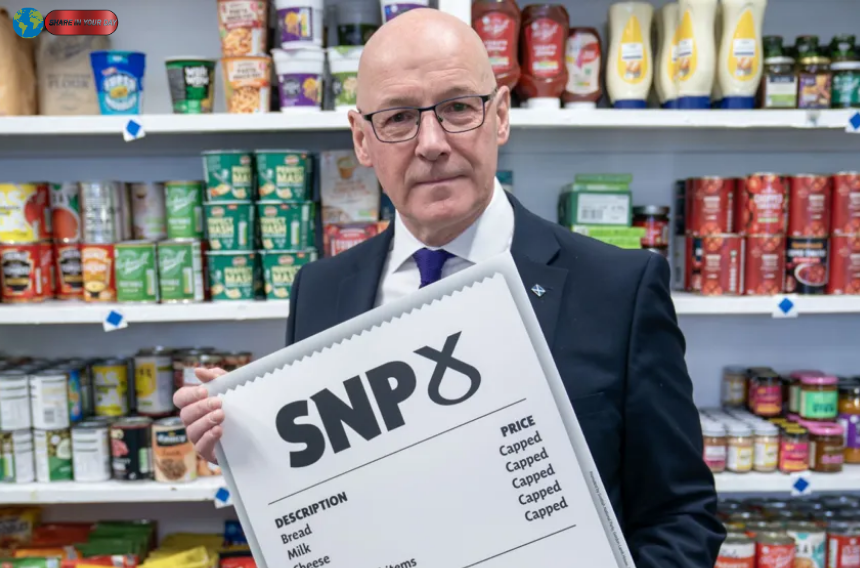
The organisations represent major parts of Scotland’s food and retail economy, including supermarkets, food manufacturers, farmers’ suppliers and distributors. In a joint letter to Swinney, they described the proposed statutory price cap as unnecessary and ineffective and argued that it would not address the underlying causes of higher food prices.
The intervention comes at a politically important moment. Swinney is preparing to set out his Programme for Government, while the Scottish government faces pressure to demonstrate that it can deliver on its election promises and tackle the cost-of-living pressures affecting households.
The proposed policy was included in the SNP’s election manifesto. It would give the Scottish government powers to require large supermarkets to limit the prices of selected essential foods, including staples such as milk, eggs, cheese and rice.
However, the business community says putting a legal ceiling on prices could treat the symptoms rather than the causes of food inflation.
Scotland Food Price Cap Faces Major Business Challenge
The strongest challenge so far has come from a coalition of 23 business organisations.
The groups include the Scottish Retail Consortium, Food and Drink Federation Scotland, Scottish Bakers and Dairy UK. Their members span retail, food production, manufacturing and distribution and collectively represent a substantial part of Scotland’s food economy.
Their message to Swinney was direct: reconsider the policy before introducing a statutory food price cap.
The organisations said they share the government’s goal of improving living standards and reducing pressure on household budgets. But they argue that a legal price ceiling would not solve the structural problems responsible for higher food costs.
Those problems include rising production expenses, refrigeration costs, transportation and distribution charges, energy prices and other supply-chain pressures.
The business groups also warned that forcing businesses to absorb additional costs could eventually have consequences for consumers.
What Is John Swinney’s Food Price Cap Plan?
The proposal comes from the SNP’s election manifesto and is designed to address the affordability of basic food.
Swinney has argued that too many people are struggling to afford a basic nutritious shop. His government has presented food affordability as both an economic and public-health issue.
Under the proposal, large supermarkets would be required to limit the price of selected essential food products.
The precise list of products, the level of any price limits and the mechanism for enforcing the policy have not yet been fully established.
That uncertainty is one of the issues highlighted by businesses.
A food price cap sounds straightforward: if an essential product becomes too expensive, the government could establish a maximum price.
In reality, food prices are affected by a long chain of costs.
A loaf of bread, for example, involves farmers, ingredient suppliers, manufacturers, energy providers, transport companies, warehouses, retailers and workers. A legal limit at the retail stage does not automatically reduce the costs incurred earlier in that chain.
That is the central argument made by opponents.
Why Business Groups Say the Policy Could Fail
The 23 organisations argue that a statutory cap would not address what they describe as the root causes of elevated food prices.
Those causes include increased production, refrigeration and distribution costs. Supply-chain disruption following the Covid pandemic and international conflicts has also increased the cost of fuel, fertiliser and energy.
The groups say additional taxes and employment-related costs have added further pressure.
If those costs continue rising while retailers are legally restricted from increasing prices, businesses could be forced to absorb the difference.
That could affect profit margins.
It could also influence decisions about which products retailers stock and where they source them.
The business groups therefore argue that policymakers should focus on reducing the costs that enter the food supply chain rather than imposing a price ceiling at the end of it.
1. A Price Cap Does Not Automatically Stop Inflation
One of the biggest concerns is that a price cap could hide inflation rather than eliminate it.
If the cost of producing a product increases but the retail price cannot rise beyond a legally imposed limit, someone else must absorb the additional expense.
That could be the manufacturer.
It could be the retailer.
It could be the farmer.
Or the cost could eventually appear elsewhere in the shopping basket.
Ewan MacDonald-Russell, deputy head of the Scottish Retail Consortium, argued that price caps do not tackle food-price inflation and described the proposal as a policy that could simply move costs elsewhere.
This is a crucial point in the debate.
A government can control the displayed price of a product more easily than it can control the underlying cost of producing and distributing that product.
If those underlying costs remain high, the economic pressure does not disappear.
2. Retailers Could Face Pressure on Profit Margins
Food retail is a competitive industry with relatively tight margins.
Large supermarkets operate at enormous scale, but they also face substantial expenses. These include wages, electricity, refrigeration, property costs, transportation, logistics and technology.
A statutory price cap could place additional pressure on those margins.
If retailers cannot increase the price of selected products when costs rise, they may have to find savings elsewhere.
That could mean reducing promotions, changing suppliers, adjusting product ranges or increasing prices on goods that are not covered by the policy.
Critics therefore worry that a policy designed to reduce the cost of a small number of essential items could have wider effects across the market.
The Scottish Retail Consortium has also warned that smaller shops could be placed at a disadvantage if they are not covered by the same rules.
3. Smaller Shops Could Be Put at a Disadvantage
The proposed policy is expected to focus on large supermarkets.
That creates another potential problem.
If large retailers are legally required to cap certain prices while smaller independent shops remain outside the scheme, the two types of businesses could face different pricing rules.
A supermarket with enormous purchasing power may already be able to negotiate lower wholesale prices than a small independent retailer.
If the supermarket then receives a legal advantage on selected products, smaller businesses could find it even harder to compete.
This could be particularly significant in rural areas and smaller Scottish communities, where independent shops often play an important role.
The debate is therefore not simply about whether consumers pay less for milk, bread or cheese.
It is also about how government intervention could reshape competition between different types of retailers.
4. Critics Point to International Experience
Business representatives have also raised concerns about what could happen if Scotland introduces a food price cap.
MacDonald-Russell pointed to Hungary as an example where price controls were associated with shortages and changes in the availability of products. He argued that the Scottish government should examine international experience before introducing similar measures.
The lesson opponents want policymakers to consider is that price controls can produce unintended consequences.
When a government restricts prices below what businesses believe is economically sustainable, companies may respond in different ways.
They might reduce supplies.
They might change sourcing decisions.
They might increase prices on other products.
Or they may find alternative ways to recover their costs.
None of those outcomes necessarily helps households dealing with the broader cost-of-living crisis.
5. The Policy Could Create a False Sense of Progress
Another criticism is political.
A price cap is easy to communicate.
The concept can be reduced to a simple promise: essential food should not become too expensive.
That message is likely to appeal to households struggling with grocery bills.
But opponents argue that the simplicity of the policy may make it appear more effective than it actually is.
The central question is whether consumers would genuinely spend less overall.
If capped products become cheaper but businesses raise prices elsewhere, the total cost of a shopping basket could remain high or even increase.
The business groups have warned that the cost of administering the scheme, combined with the effects of the cap itself, could ultimately be absorbed by businesses and consumers.
That makes the policy difficult to evaluate without knowing exactly how it would work.
Scotland’s Food Inflation Problem Is Real
Despite the business opposition, there is an important point on which both sides agree: food affordability is a serious problem.
Households across Scotland have faced pressure from higher food and household costs.
For lower-income families, increases in essential products can have a much larger impact because food represents a greater proportion of their household spending.
That means the Scottish government’s motivation is not difficult to understand.
The disagreement is about the best solution.
Swinney’s government believes intervention may be necessary to make nutritious food more affordable.
Business organisations argue that structural measures would be more effective.
They want policymakers to address the costs faced by farmers, manufacturers, transport companies and retailers rather than simply limiting the final selling price.
What Businesses Want Instead
The business groups have not simply called for the government to do nothing.
Their broader argument is that reducing costs throughout the food supply chain would provide a more sustainable solution.
That could involve measures targeting energy expenses, production costs, logistics, investment and support for food producers.
The groups have also emphasized the importance of working with businesses when developing policies affecting the food sector.
That approach could allow the government to identify where costs are increasing and where intervention might produce the biggest benefit.
Instead of asking supermarkets to sell a product below a certain price, policymakers could potentially look for ways to make it cheaper to produce and distribute that product.
The distinction is important.
A price cap controls the outcome.
Supply-chain reforms attempt to change the conditions that create the price.
Swinney’s Political Promise Is Now Under Pressure
The Scotland food price cap has become one of the more politically sensitive parts of Swinney’s economic agenda.
The proposal was an election commitment, meaning abandoning it could create criticism from voters and political opponents.
But continuing with the policy could intensify opposition from the business community.
That leaves Swinney facing a difficult choice.
He can argue that government intervention is necessary because existing market mechanisms have not delivered affordable food for everyone.
Or he can revise the policy in response to concerns from retailers and producers.
Either approach carries political risks.
If the government proceeds, it will need to explain exactly how the scheme will operate and how it will prevent unintended consequences.
If it abandons the proposal, critics could accuse the SNP government of breaking another election promise.
The Programme for Government Could Be Crucial
The timing of the business letter is particularly important because Swinney is expected to outline his Programme for Government.
That announcement should provide a clearer picture of how the Scottish government intends to move forward with its election commitments.
The food price cap is likely to receive attention because it combines several major political issues: household finances, business regulation, inflation and public health.
The government will also have to explain whether it remains committed to a statutory system and, if so, when legislation will be introduced.
Businesses want clarity.
Consumers want lower prices.
The government wants to demonstrate that it can deliver on its promises.
Those objectives are not necessarily incompatible, but the method of achieving them remains highly contested.
Could the Food Price Cap Actually Make Shopping More Expensive?
This is one of the most important questions surrounding the proposal.
The answer will depend heavily on how the legislation is designed.
If retailers can absorb the cost without changing other prices, consumers could benefit from cheaper essential products.
But if retailers compensate by increasing prices elsewhere, reducing promotions or changing product ranges, the overall benefit could be much smaller.
The business groups argue that the second scenario is a serious possibility.
They say businesses cannot simply eliminate rising production and distribution costs.
Those expenses have to be paid somewhere in the system.
That is why opponents believe the government should focus on the supply chain instead of imposing a legal retail ceiling.
The Bigger Debate: Market Intervention vs Cost Relief
The argument over the Scotland food price cap reflects a much wider economic debate.
Governments around the world regularly face pressure to intervene when essential goods become unaffordable.
Price controls can provide immediate relief in certain circumstances.
However, they can also create distortions when the underlying supply and demand conditions remain unchanged.
The challenge for policymakers is finding the right balance.
Consumers need affordable food.
Businesses need to remain financially viable.
Farmers and producers need sustainable prices.
And governments need policies that can survive changing economic conditions.
A successful policy would ideally support all four.
That is what makes Scotland’s current debate so significant.
What Happens Next?
The immediate next step will be closely watched.
Swinney’s government is expected to provide more detail about its priorities and policy plans.
If the food price cap remains on the agenda, businesses are likely to continue pressing for changes.
The government could potentially consult further with retailers, producers and consumer organisations before deciding how to proceed.
The precise design of the policy will matter enormously.
Questions remain over which products would be covered, which retailers would be affected, how prices would be calculated, how long the restrictions would last and how the rules would be enforced.
Until those details are available, it is difficult to determine exactly how the policy would affect Scottish households.
5 Key Takeaways From the Food Price Cap Dispute
The current debate can be summarized in five points.
First, 23 business organisations have urged John Swinney to abandon the proposed statutory food price cap.
Second, the groups argue that a price ceiling would not address rising production, energy, refrigeration and distribution costs.
Third, the Scottish government says food affordability is an important cost-of-living and public-health issue.
Fourth, businesses warn that the policy could create unintended consequences, including pressure on retailers and possible disadvantages for smaller shops.
Fifth, the future of the proposal could become clearer as Swinney sets out the Scottish government’s next programme of work.
Final Thoughts
The Scotland food price cap debate is ultimately about a simple question with a complicated answer: how can government make essential food more affordable without creating new costs elsewhere?
John Swinney’s government believes action is needed because many households are struggling with the price of a basic shop. The proposed cap offers a straightforward political response by targeting the prices of essential products.
But Scotland’s business community argues that the policy attacks the final price rather than the underlying causes of inflation.
Twenty-three organisations have now called for the plan to be abandoned, warning that production, energy, refrigeration and distribution costs must be addressed instead.
The coming weeks could determine whether Swinney modifies the proposal, pushes ahead with legislation or searches for a different way to reduce food costs.
For Scottish households, the outcome matters far beyond the political debate.
If the government gets the policy right, it could provide meaningful help to people struggling with grocery bills.
If it gets the balance wrong, however, the intervention could create additional pressure on the businesses responsible for producing and selling the food Scots rely on every day.
The challenge now is to turn the political promise of cheaper food into a policy that delivers real savings without shifting the costs somewhere else.