Trump-Xi Summit Puts AI, Trade and Taiwan at Center of US-China Tensions
Donald Trump and Chinese President Xi Jinping held a closely watched summit at the White House on Thursday, bringing the leaders of the world’s two largest economies together at a moment of intense competition over artificial intelligence, trade, Taiwan and global security.
Xi’s visit, his first trip to Washington in more than a decade, was marked by elaborate ceremony and diplomatic symbolism. Trump welcomed the Chinese leader at Joint Base Andrews before hosting him at the White House, where the two presidents held discussions that lasted roughly 90 minutes.
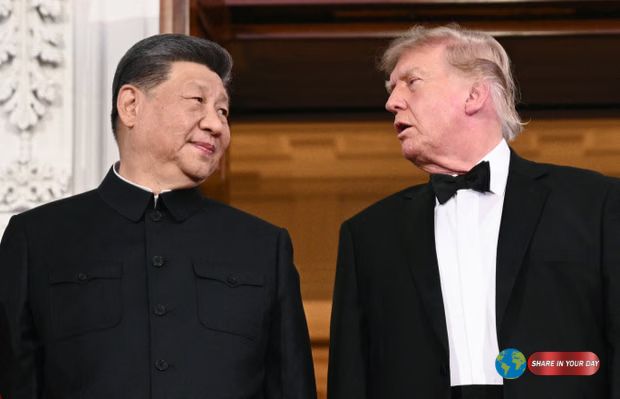
Despite the highly choreographed reception, the meeting produced few indications of major breakthroughs on the most difficult disputes between Washington and Beijing.
The two governments did agree to extend an existing pause in their trade conflict until January 10. The extension provides both sides with additional time to negotiate, but it does not resolve the broader disagreements that have driven repeated tariff battles between the United States and China.
AI Becomes a Major Point of Competition
Artificial intelligence was among the most closely watched subjects at the summit.
Trump has increasingly used the phrase “super intelligence” when discussing advanced AI and signaled before the meeting that he did not want additional restrictions to interfere with technological development. China has also invested heavily in AI as Beijing and Washington compete for technological leadership.
Xi struck a somewhat different tone during his public remarks, saying that the development of artificial intelligence should remain under human control.
The contrasting emphasis reflects a wider challenge facing both governments. Washington and Beijing have strong incentives to maintain their technological advantages, while policymakers and technology experts are also confronting questions about safety, regulation, computing power and the potential consequences of increasingly capable AI systems.
The summit did not appear to produce a comprehensive framework for resolving those differences.
Instead, AI remains one of the areas where economic competition and national security concerns overlap most directly. Restrictions on advanced technology, access to computing resources and competition among major technology companies have increasingly become part of the broader US-China relationship.
Trade Truce Extended
Trade remained another central issue.
The United States and China have spent years imposing tariffs and other restrictions on one another, creating uncertainty for companies and industries that depend on global supply chains.
The latest agreement extends the current pause in the trade conflict, offering temporary stability to businesses while negotiations continue.
Trump highlighted the possibility of increased market access for American farmers and ranchers, while Chinese officials have emphasized the importance of a more stable relationship between the two economies.
However, the extension does not eliminate the underlying disputes. The countries continue to disagree over market access, technology, industrial policy and the strategic role of Chinese manufacturing.
For businesses, the immediate effect is greater certainty that another escalation has been postponed. The longer-term direction of US-China trade remains unresolved.
Taiwan Remains a Major Fault Line
Taiwan was another sensitive issue surrounding the summit.
China claims Taiwan as part of its territory and opposes moves toward formal independence. The United States does not maintain formal diplomatic relations with Taiwan but has longstanding security and economic ties with the island.
According to a Chinese government readout, Xi urged Trump to oppose Taiwanese independence during their discussions.
The meeting also drew attention to a roughly $14bn US arms package for Taiwan that Trump had previously indicated was being held in abeyance. The issue has generated concern among some US lawmakers and regional allies, particularly because military support for Taiwan is closely connected to broader questions about deterrence in East Asia.
At the same time, Beijing continues to regard American arms sales to Taiwan as interference in what it considers an internal Chinese matter.
The summit therefore offered little evidence that the fundamental disagreement over Taiwan had been resolved.
Xi Calls for Cooperation
Xi used the meeting to emphasize the dangers of confrontation between Washington and Beijing.
He referred again to the so-called “Thucydides Trap,” the idea that rivalry between an established power and a rising power can increase the risk of conflict.
Xi argued that stronger communication, continued dialogue and military-to-military contact could help prevent tensions from escalating.
He also promoted greater people-to-people exchanges, including opportunities for young Americans to visit China.
Trump, meanwhile, described his relationship with Xi in positive terms and portrayed the meeting as an opportunity to make progress on several issues.
The contrast between the ceremonial warmth of the summit and the unresolved policy disputes underneath it was one of its defining features.
A Summit Heavy on Symbolism
The visual presentation of Xi’s visit received considerable attention.
Trump personally greeted Xi at Joint Base Andrews, an unusual gesture for a visiting foreign leader. A B-1 bomber flew over during the arrival ceremony, while American and Chinese flags were prominently displayed at the White House.
After their meeting, Trump showed Xi the newly constructed White House helipad.
The White House state dinner also brought together some of the biggest names in American technology and business. Guests included Apple chief executive Tim Cook, Amazon founder Jeff Bezos, Alphabet chief executive Sundar Pichai, OpenAI chief executive Sam Altman, Tesla chief executive Elon Musk and Nvidia chief executive Jensen Huang.
Their presence underscored how closely the future of US-China relations is tied to the technology industry.
What Comes Next
The summit provided another opportunity for Washington and Beijing to prevent their relationship from deteriorating further, but it did not remove the fundamental sources of tension.
Trade negotiations will continue after the temporary truce extension. Competition over artificial intelligence is likely to intensify as both governments seek technological advantages. Taiwan will remain one of the most sensitive security questions between the two countries.
For now, the summit appears to have created additional space for diplomacy rather than delivering a sweeping reset in relations.
The next phase will depend on whether the two governments can turn the positive language surrounding the meeting into concrete agreements on trade, technology and security.
With US-China competition continuing across economic, technological and military spheres, the importance of the summit may ultimately be measured less by its elaborate ceremonies than by what Washington and Beijing do after the cameras leave.